


Passing Through
Madison Avenue Presbyterian Church - Outreach - Blogs - TEEZing Out The Roots
As you know from my last post, I was recently in the Luapula Province. This province gets its name from the Luapula River, which forms the border between Zambia and the Democratic Republic of the Congo and is a section of the mighty Congo River. In conversation with the language experts of the TEEZ office, I have learned that “luapula” means “passing through.” This is specifically in reference to the fact that the river passes through Lake Bangweulu and Lake Mweru, both of which we visited on our recent training. So, the river continues on its course through these two massive bodies of water, maintaining its current and trajectory. I was told that people who go out on fishing boats on these lakes have to be extra careful, because if they get caught in the Luapula’s current they will end up much farther afield (alake?) than expected. The relatively calm waters of the rest of the lake remain calm, but the river’s current is swiftly passing through.
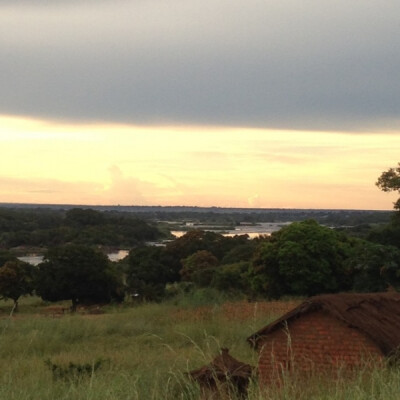
Looking across the Luapula River into the DRC
This natural phenomenon of a river running through stationary lakes has captured my reflective world. I imagine fish, flotsam, and jetsam with origins upstream making their way steadily through a lake with its own fish, flotsam, and jetsam existing completely in its closed ecosystem. It is the clearest picture I can imagine of the tension between the temporary and the permanent, the transient and the settled, the uncertain and the committed. The reason this has loomed so large in my reflective world is that I am constantly trying to navigate these tensions, yes in my life in general, but especially in my time in Zambia. No matter what I do or how I exist here, I always have the reality of my transience in the back of my mind. There is a clear end date to my physical presence here, and I am well beyond halfway to that point. This is a reality that impacts how I do ministry, how I form and maintain relationships, how I spend money, and even how I think about “home.” This is a reality that makes me take a critical look at the ethics of cross-cultural ministry in a time-limited format and therefore at the ethics of my very presence. I have never had much of a problem with being fully present wherever I am; indeed I often have the problem of becoming so involved in my present context that I neglect my other contexts. Thus, I find myself worrying in advance about what will happen to the deep bonds I have formed with people in real life, especially as many don’t have a virtual life. I worry about the impact of my passing through on their emotional and spiritual selves. I worry about the impact of my passing through on my own emotional and spiritual self.
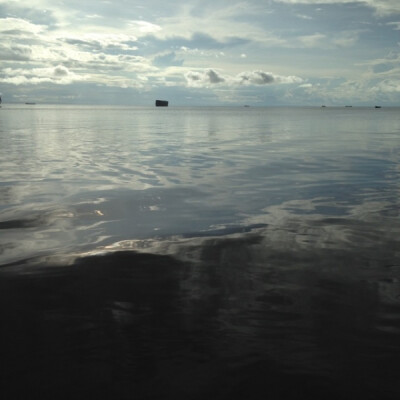
Lake Mweru, through which the river passes
For, I am finally learning and understanding interdependence. The very fact that I am learning this truth of life is proof that I do have roots here that are being nourished. I am deeply connected to people and ways of life here, and people and ways of life here are deeply connected to me. I see this regularly in various scenarios. Here are some snapshots:
—Recently we have been experiencing weekends without water (which I’ve dubbed WWW). Sometimes it is due to infrastructure failure and sometimes to actual water shortage. Regardless, it seems to disproportionately impact the little corner of MEF in which I stay. I am sure that it happens on weekends because the offices of the many institutions are not open to feel the loss and therefore correct it. We have learned to keep reserves, but Monday morning usually finds us in need. So, Monday morning can find about 12 of us—women, men, children, yard laborers, maids, and reverends—gathered around the “watering hole” of the Anglican seminary’s elevated water tank with buckets, bottles, tubs, and any other large containers we can get our hands on. Waiting on the slow trickle from the tap to fill each container, we commune in our commiseration.
—Last week was birthday week for both my mom and grandpa, and I was feeling especially homesick. On the day of my mom’s birthday I found out that my dear friend and Bemba teacher (who happens to be the namesake of the great and unfortunately late Prince) was born on the same day many years later. Knowing that it was unlikely that his big day would have been celebrated at home, I rallied the community of people who have grown to love him and had a surprise birthday party. It was so natural and normal, with singing, cake, presents, laughter, and love. It felt like home.
—I was away from Chimwemwe Presbyterian Church for three weeks due to our training schedule. Yesterday I was finally back. This was a blessed day to return, as it was women’s Sunday. The preaching, the presiding, and the singing were all done by the women. At the end of the service there was a small fundraiser for the women’s fellowship and women’s events. Mathilda, a leader in the congregation, often jokes with me about switching languages so that she would speak English and I would speak Bemba. In the middle of this fundraiser the emcee started switching back and forth between Bemba and English, and Mathilda stood up and said in the clearest English I have heard from her, “Speak English so that our English abusa (pastor) can understand.” I knew from her that this was a challenge for me to get better a Bemba. For everyone else it was a source of great hilarity. This scene was one of comfort and familiarity. We can throw jabs at each other and laugh about it.
All of this is to say that even though I know I am in the swift currents of the river it sure feels like I am in the waters of the rest of the lake. I am a lily or lotus or some other water plant with roots in the calm lake and pod in the river current. This current will start to feel like it is becoming stronger and stronger, a result of the time drawing nearer as well as of our newly busy training schedule that will take me to other parts of this beautiful country and away from my community here. Then, before I know it, I will be torn loose and carried downstream and out of the lake. I know I will be able to navigate it. I have done so before. But I realize now more than ever how painful this will be for me and my loved ones here. I also realize that I will be going back to a lake that is just as significant, just as meaningful, and in which I have long-planted roots. With all of the complicated emotions going through me right now, though, those roots will most certainly need to be teased out.

Happy Birthday, Prince!