

Madison Avenue Presbyterian Church

Go
TEEZing Out the RootsImage

Chasing After Wind

Madison Avenue Presbyterian Church - Outreach - Blogs - TEEZing Out The Roots

As part of my fellowship I am required to periodically write theological reflections relating to my time in Zambia. I thought this one would be good food for thought for this blog.

“Again I saw all the oppressions that are practiced under the sun.  Look, the tears of the oppressed—with no one to comfort them!  On the side of their oppressors there was power—with no one to comfort them.  And I thought the dead, who have already died, more fortunate than the living, who are still alive; but better than both is the one who has not yet been, and has not seen the evil deeds that are done under the sun” (Ecclesiastes 4:1-3).


These lines from Ecclesiastes offer one of the most exquisite expressions of despair I have ever come across. They take the refrain of “Everything is vanity!” and give it meat, filling it out with the realities of oppression. The oppressors have power and continue to gain power over the oppressed who have tears and continue to shed tears. In saying that neither the oppressed nor the oppressors have anyone to comfort them, the teacher reveals that this unjust relationship creates a condition of brokenness for both. The teacher then shows that this condition of brokenness rooted in unjust power relationships has become systemic in all the world. For, it is better to be dead and still better to have never been born than to witness this evil that exists under the sun.

I cannot help but read this in light of the teacher’s image of chasing after wind—an image evoked no fewer than nine times throughout the short book (1:14, 1:17, 2:11, 2:26, 4:4, 4:6, 4:16, 5:16, 6:9). It is an image illustrating what is often interpreted as the futility of our actions, from the toil of our hands to the quest for wisdom. The teacher initiates this image in the opening chapter by describing the circuitousness of the wind, going round and round and back again (1:6). In effect, when we embark on the impossible journey of chasing the wind we end up running in circles, retracing over and over again the same steps we and others have taken before.

Having spent significant time in India and now in Zambia, I have gotten much more in touch with paradigms of circular continuous time in which patterns of life and history repeat themselves as time progresses towards some end—of course with the belief that perhaps after that end it all might start over again. I include “continuous” not only because time still progresses but because there is a general continuity of life in the persistence of spirits, ancestors, and even the self on this same plane of existence after death. I do not buy into the often oversimplified distinction between Western paradigms of time as linear and progressive and Eastern paradigms of time as circular, but I do think that in broad strokes the West has been more controlled by the narrative of progress. 

I think that the teacher of Ecclesiastes is also more prone to view the world through the narrative of progress, though perhaps with a healthy understanding that progress should not be the end goal of life. With progress as the major driving narrative, each repeating pattern seems like a failure, as it shows we have not learned from what has come before. It thus makes sense that chasing the wind in circles and realizing that there is nothing new under the sun would cause great exasperation and despair. If, however, the seeming failures and futilities of life were viewed through the lens of circular continuous time, there would be an acknowledgement and even acceptance that history repeats itself. The key, though, is that these circular repetitions are still continuing along toward some end. Further, without linear progress as the central narrative, there would also be more acknowledgement of the good that is repeated throughout history as well as the incremental growth that does occur.

I am learning that I need to keep integrating my linear progressive paradigm with the circular continuous paradigm, for if I do not then I will indeed sink into the despair portrayed in the verses at the head of this reflection. It is difficult to be away from the U.S. each time there is another mass shooting, another black life lost to State violence, another hate crime, another drone campaign, and another weekend of killings in Chicago. Every single time I hang my head and cry out, “Why haven’t we learned? How do we allow this to keep happening? There is no comfort for the oppressed! There is no comfort for the oppressor!” 

The same thing happens when I see the recolonization of Africa and the rise of despots and civil wars on the continent. Along with continued neocolonialism by major corporations, there seems to be an actual recolonization by China. Money is paid to governments, and Chinese companies take over the extraction industries. They even bring their own laborers, increasing the unemployment rate for African laborers. I cannot help but think of the history of colonization by trade companies—i.e. The Congo by the Belgian trade company under Leopold  and the many places across Africa and Asia by the Dutch and British companies. Likewise, the likes of Robert Mugabe and Joseph Kabila remind me of Latin American and European leaders of old who took their countries to hell just for the sake of staying in power. Finally, the flaring up of civil wars in the Central African Republic and South Sudan hearken to those in Rwanda and the Sudan. Again, the temptation is to despair.

And then there are those persistent oppressions that happen across contexts. Patriarchy, racism, colorism, casteism, homophobia, ableism, human trafficking, and xenophobia all lead to daily acts of systemic and interpersonal violence. These phenomena also seem cyclical to me. They repeat themselves and compound each other, and then when progress is made in one area we choose new identities to otherize and oppress. This can be seen in rising violence against migrant workers and albinos here in Zambia and in rising xenophobia and Islamophobia in the U.S. And of course we cannot forget our own individual patterns of behavior, of relapses, of neuroses, and of repeat relational mistakes. Linearly it is failure after failure after failure. We move forward in time, but we do not learn.
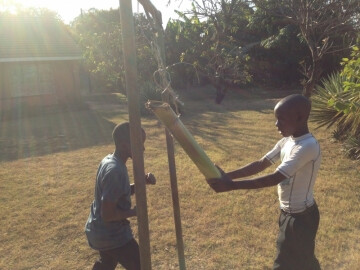
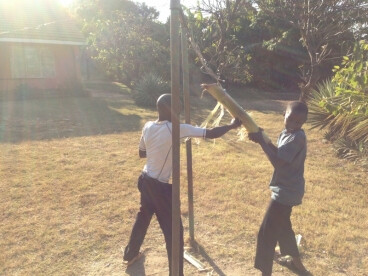
Sometimes making a punching bag out of a banana tree trunk and then walloping it as a release of frustration seems like the best way to deal with the repeating troubles of this world.

Now, there is of course a bit of fate or a loss of free will inherent to the paradigm of circularity. But that is also there in certain doctrines of providence. It does not have to be defeatist or fatalistic. It can be a simple acknowledgement that things may happen that are beyond our control, and we can expect those things to look like that which has come before. In light of this, we Christians should take heart and have great hope. For, if we look at time as carrying circular patterns moving us towards an end goal then we should notice the repeating patterns of creation, fall, and re-creation; life, death, and resurrection; wholeness, brokenness, and reconciliation; righteousness, sin, and redemption. With these repeating cycles as the driving patterns of our faith, then we should be the people of hope in this world.

We should acknowledge the fall, death, brokenness, and sin, but we should proclaim re-creation, resurrection, reconciliation, and redemption. We should also proclaim the fact that God decisively broke into the patterns of this world through the Incarnation, changing the trajectory from a downward spiral to an upward whirlwind. And through the Incarnation we were given an imperative not only to live as people of hope but to be active agents in bringing about that which is hoped for. This means that we must do all that we can to hasten the coming of re-creation, resurrection, reconciliation, and redemption each time we find ourselves in a moment of fall, death, brokenness, and sin.

When we spiritually dwell on the latter, then we inevitably extend the reality that we physically dwell there. We allow the oppressive stage of the cycle to become that which dominates the most time. If, however, we dwell on the hope and indeed promise of our faith that we have seen over and over again, then we can actively fight and shorten the time of oppression. As we strive towards this, then I believe we will also press onward more rapidly towards that end goal, the completion of the Kingdom. At the level of daily life this should change our entire perspective. We should recognize evil, but we should dwell on that which defeats evil. We should lift up the re-creations and resurrections that occur all the time in every context. We should change the entire narrative that gives power to oppression and defeatism as a response.

When we make this our work, then indeed we should rejoice in our toils. When we are celebrating re-creation, resurrection, reconciliation, and redemption, then we should indeed enjoy our food and drink. When we understand that the object of chasing the wind is not catching the wind but rather learning from the steps we have traced before, then all will not be vanity. And when we change society so that the fall, death, brokenness, and sin are not the dominant realities, there may just be fewer oppressions under the sun. Then there would certainly be something new under the sun.

 
Posted July 18, 2016


in Race, Hope

Lessons from Zambia in Light of a Shooting Massacre of Queer People of Color

Madison Avenue Presbyterian Church - Outreach - Blogs - TEEZing Out The Roots

Last night I sobbed.  A tremendous weight settled itself onto my shoulders, which already carry the majority of the stress of my body.  It was difficult to breathe.  Everything felt heavy.


50 people dead in another mass shooting in the USA.

Queer people of color once again targeted—at least 49 murdered, 53 more wounded.

A gunMAN driven by the ideology of the fundamentalist wing of his religion.

A gunMAN so warped by the power of gay hate that he may have even internalized it against himself and externalized it against those he found attractive.

A sacred, brave, and safe space invaded, assaulted, raped, made no longer safe.

Families’ lives shattered—some that were whole, some that were heartbreakingly estranged, some that were about to start in exciting and creative ways.


The logical result of the hate proclaimed in fundamentalist churches, fundamentalist mosques,  and fundamentalist temples.

The logical result of the hate proclaimed in city halls, state houses, Capitol Hill, and campaign trails controlled by extremist ideology.

The logical result of the hate proclaimed by a nation that refuses to restrict the proliferation of weapons of mass destruction (all guns, especially assault weapons).

The logical result of the hate proclaimed by a society that persistently equates masculinity with power and power with violence.

The logical result of the hate proclaimed by systems at all levels of our existence that enforce the oppression of people of color, people of queer sexualities, people of queer gender identities, people of marginalized religions, and especially people who embody intersections thereof.

When I woke up I found myself in a state of paralysis.  A significant part of me wanted to do nothing besides my duties of the day, to teach our lessons, eat, and then get back in bed until a new sunrise.  A significant part of me wanted to do something, anything.  I wanted to engage in some more spirited battles on social media.  I wanted to disengage entirely because of how inexplicably draining that is.  I wanted to sit alone in silence.  I wanted to speak, shout, and scream.  Then I realized that I have this blog with a very specific purpose and platform: to detail my experiences in Zambia and lift up from those experiences that which can be instructive for the U.S. American context.  So, I have decided to do just that—to detail some experiences here that are directly related to the issues at hand in this massacre via assault weapon of queer people of color.


Gay Hate

I use the term “gay hate” because “homophobia” linguistically relieves the person and the society of blame.  We usually think of a phobia as something that is not chosen.  The hateful attitudes held and acts done by dominant people and dominant society, however, are chosen.  I use “gay hate” to describe those attitudes and acts.

To begin with, it should be made clear that homosexuality is categorically illegal in Zambia.  That being said, since independence there have been very few if any prosecutions of people for homosexual “acts.”  Unsurprisingly, the law is a vestige of colonial law, maintaining the same language as codified by the colonizing British empire.  Further, the Zambian constitution has an anti-discrimination clause that seems to protect people from the still existing British colonial law.

Knowing about this law and having heard about other people’s experiences in different parts of Central and East Africa, I fully expected to hear regular gay-hating rhetoric from the government, from pulpits, and in everyday conversation.  In short, I expected to hear what so many people in certain parts of the U.S. regularly hear.  On the whole, though, I have been pleasantly surprised.  I have encountered gay hate on only four occasions over the past nine and a half months.  The first was a statement made by a white United Methodist missionary.  The second was a statement made by a white PC(USA) mission co-worker.  The third was a statement made by a white American Baptist missionary.  Are you seeing the trend here?  The final was a Zambian preacher at a wedding railing against “Adam and Steve”…a clear import from U.S. American rhetoric.

I will not minimize the struggles of the LGBTQI community here.  They have to be largely silent in a largely conservative country.  There is very little “coming out” because to do so risks not only expulsion from the family and the church but also the possibility of longterm imprisonment under the British colonial law (a real fear even if not an actualized reality).  They survive in whatever ways they can, which all too often means living fully into their identities only behind closed doors and in very secret places.  What I mean to do is point out that the gay hate I have encountered here is of a distinctively Western flavor.  I am sure that there has been a lot of gay hate in Zambia throughout history, as such is the case in all societies.  Overall, though, it seems that the homophobia of today (yes, for this one I actually do mean fear of homosexuality) has largely been thrust upon the country by the gay hate of Western governments and Western missionaries.  The same rhetoric that leads to systemic oppression in the U.S. and that laid the groundwork for this shooting massacre is continually being exported to other places and contexts, laying the groundwork for unknown horrors to come.

What can I lift up as instructive to the U.S. American context?  Our actions as a society, the systems of oppression we create, do not remain isolated to the U.S.A.  They have real impacts in other contexts, deeply affecting whole societies, marginalized communities, and vulnerable individuals.  These impacts are especially profound when carried by representatives of faith to deeply religious societies.  The impacts we have, though, don’t have to replicate oppression.  We can export radical inclusivity, openness, and affirmation of identity.  We can export the hope of survivors and victors over systemic oppression.


Guns

I regularly field questions here about why guns are so readily available in the U.S.A. and why we are not doing anything to make them less available.  It is “regularly” because there have regularly been mass shootings in the U.S.A. during my time here, and once again what happens in the U.S.A. does not remain isolated to the U.S.A.  People are shocked by the callousness of a national belief that a right to carry guns is more valuable than a right to live.  They shake their heads.  They say, “Shame.”  They ask, “Why?”  Even as I sit here writing this, my colleague Rev. Changwe is saying it is quite obvious that these things won’t stop happening until we change our laws on guns.  In Zambia only military personnel, police, and security guards carry guns.  I have never seen a gun elsewhere.  There have not been shooting massacres in Zambia since the British left.

What can I lift up as instructive to the U.S. American context?  I think it is pretty self explanatory.  People in Zambia see the U.S.A.’s gun love as ridiculous and evil.  The absence of guns in the general populace in Zambia means no shooting massacres and very few shooting deaths.  We have a lot to learn.


Racism and Disproportionate Impacts of Violence on People of Color 

Every time there is a shooting reported from the U.S., Esther, my dear mother in the TEEZ office, wants to know why people of color are always being killed…by police, by gunmen, by guns.  Not just, “Why does your society allow this continued violence,” but clearly, “Why does your society allow this continued violence against Black and Brown people?”

Every time Donald Trump says something blatantly racist or xenophobic, everybody I see asks me how it is possible that this man is so popular.  When a national figure describes Africans as “lazy fools,” people hear it and are appalled.  They want to know why so many people accept this and celebrate it.  I frequently find myself attempting to explain systemic racism in the U.S.  I frequently find myself learning about how this racism, once again, is not isolated to the U.S.

What can I lift up as instructive to the U.S. American context?  To Americans of color, people across the world are aware of your plight and are deeply affected by and concerned about your suffering.  To white colleagues, people across the world are taking note of whether or not we are fighting against systemic racism and are wondering if we will continue to accept the overt racism now being embodied by a major presidential candidate.


HOPE

Amidst all this hate, violence, and pain, I am regularly reminded through my experiences here in Zambia that there is hope in humanity.  I have dear friends who are victors over systems of death.  I see communities that band together in times of physical need, grief, and celebration.  I worship in congregations that provide sanctuary for people who are marginalized and service for communities plagued by the massive injustices of this world.  I live in a compound where people struggle together, depend on one another, and challenge each other.  I even engage in conversations initiated by clergy and lay leaders in the Uniting Presbyterian Church of Southern Africa about gay rights, including ordination and marriage.  And in these conversations I don’t hear hate.  I hear genuine concern and curiosity.  I hear faithful wrestling with something that is usually not discussed.  I share my beliefs.  I share resources from the PC(USA).  It is not hateful.  It is beautiful.

I will continue to sob.  I will continue to feel heaviness.  I will continue to shake my head.  But I won’t do so in despair.  I will learn what I can learn here and lift up what needs to be heard in the U.S.A.  I will carry inclusivity, openness, and affirmation of identity.  I will share the stories of survivors and victors.  I pray that you will join.

Posted June 14, 2016


Being planted in the rich soils of Zambia to inspire regrowth at home. “Other seed fell on good soil and bore fruit” -Matthew 13:8